Heat & sleep · Nouna
Heat exposure and sleep
A wearable panel study found roughly 15 minutes shorter sleep on heat-stress nights. Sleep analyses included 119 participants; the association does not establish causation.
Koch et al., 2023 ↗CHEERS Network / Publications
The CHEERS framework, component studies and related research connect methods, field observations and adaptation. Explore findings, methods, limitations and the published author contributions.
A guide to the evidence
Frameworks, field studies and methods — with the evidence needed to interpret them.
Browse 28 selected catalogue records, or explore the five wider papers linked from researcher profiles. Study pages retain the findings, methods, limitations and verified author lists.
This chart describes the selected library, not all publications by network researchers.
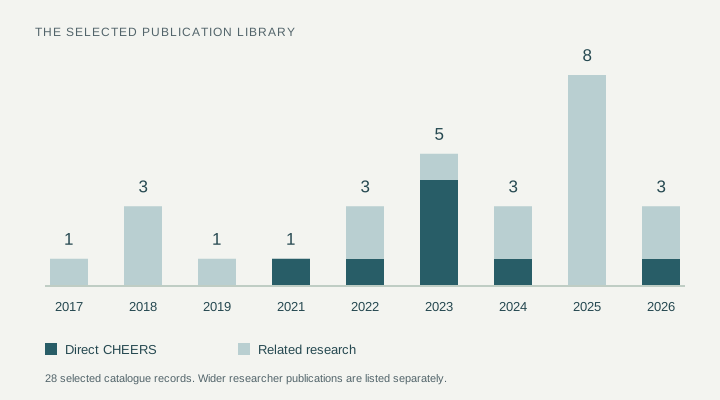
| Year | Direct CHEERS | Related research |
|---|---|---|
| 2017 | 0 | 1 |
| 2018 | 0 | 3 |
| 2019 | 0 | 1 |
| 2021 | 1 | 0 |
| 2022 | 1 | 2 |
| 2023 | 4 | 1 |
| 2024 | 1 | 2 |
| 2025 | 0 | 8 |
| 2026 | 1 | 2 |
The evidence
Explore the CHEERS framework and the connected
methods, field studies and adaptation evidence.
The library distinguishes direct CHEERS publications from related collaborative research. Open the study notes for methods, findings and limitations. We reviewed 23 papers in full text; five older or restricted-access records were assessed from abstracts or partial texts. Protocols describe study methods rather than proven effects.
Heat & sleep · Nouna
A wearable panel study found roughly 15 minutes shorter sleep on heat-stress nights. Sleep analyses included 119 participants; the association does not establish causation.
Koch et al., 2023 ↗Field methods · Early Nouna pilot
An early study reported 94–100% acceptance, alongside low physiological data coverage. Usability, technical reliability and measurement validity each need evaluation.
Huhn et al., 2022 ↗Heat & work · Burkina Faso
Research with 76 farmers analysed work timing, intensity and physiological strain across seasons. Observed patterns suggest self-pacing, with differences between women and men.
Eggert et al., 2025 ↗No publications match your search. Try a broader topic or clear the filters.
Why publish
To make methods transparent, share what we learn in the field, test assumptions and give others a foundation for better climate and health research.
Explore further
Digital Global Health publications ↗
Sources & editorial scope ↗
From the researcher profiles
Five additional papers provide wider scientific context from collaborators. Each has its own evidence summary and clearly labelled research connections.
Patil et al. · Journal of Global Health
Read the publication summary ↗2024 · Qualitative researchSunpuwan et al. · PLOS ONE
Read the publication summary ↗2019 · Study protocol and cohort methodsKorinek et al. · BMC Public Health
Read the publication summary ↗2026 · Study protocolMadyaningrum et al. · JMIR Research Protocols
Read the publication summary ↗2023 · Scoping reviewRamadan et al. · PLOS ONE
Read the publication summary ↗