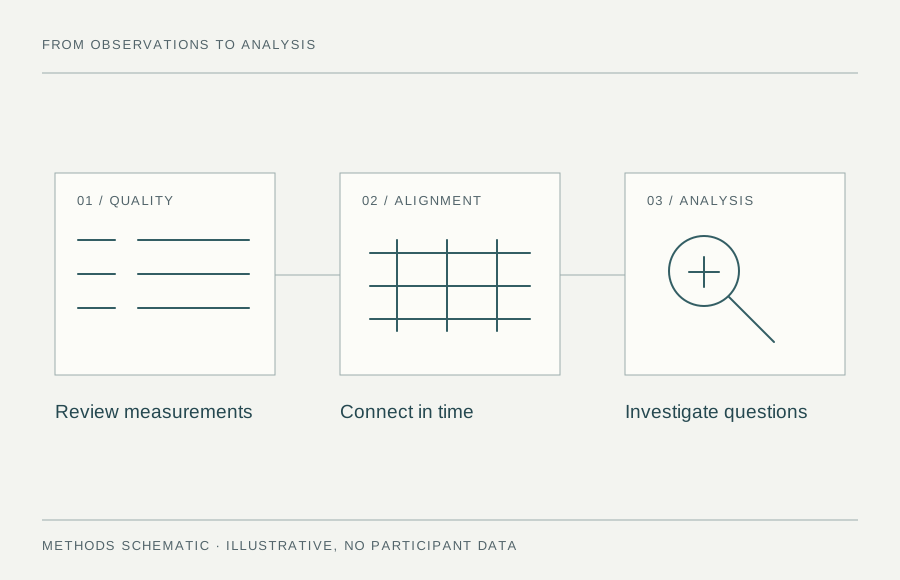
Measurements & outputs
Measurements and outputs
- Missing-data diagnostics and evaluated imputation methods.
- Statistical associations and exploratory risk patterns.
- Research into graph-based analysis and language-model approaches.
Research workflow
Research workflow
Audit data quality and define the analysis question before model development.
Evaluate imputation and prediction against suitable reference data, with separate validation and uncertainty assessment.
Interpretation & current limits
Interpretation and limitations
- Reconstructed observations are model estimates. They should remain distinguishable from measured data.
- Malaria signals and early-warning approaches are research findings requiring further validation. The network does not offer a validated diagnostic or alert service.
- Health-LLM slides discuss external research examples, rather than a deployed CHEERS application.
Documented applications & research context
Applications and research context
Projects
Research settings
Publications & evidence
Related publications
Read the study-specific methods, results and limitations. The framework paper describes the wider approach.
2026Related research evidenceAI & data quality
Wallner et al. · npj Digital Medicine
Studies generative reconstruction of missing wearable heart-rate data and its potential to support disease-signal detection.
Methods, findings & limitations ↗2026Related research evidenceData architecture
Yan et al. · Studies in Health Technology and Informatics
Shows how Nouna population, weather, wearable and indoor climate datasets can be linked in a knowledge graph.
Methods, findings & limitations ↗Explore the full publication library ↗Methods in exchange
Related workshops
Source & scope
Sources and scientific context
Content and images draw on Sandra Barteit’s Freiburg lecture, The Impact of Climate Change on Human Health: Lessons from Low- and Middle-Income Countries, slides 40, 51, 56, 57, 58, 62. Publication pages provide the corresponding research evidence. Reviewed 12 November 2026.
Images extracted from the lecture retain the original device or research illustration. Product images identify examples used in the source material.