Dr Sandra Barteit ↗
Research Group Lead / Principal Investigator
Role / research source ↗Data architecture and AI · Heidelberg · Research partnerships in Africa and Asia
Using graph databases and AI to investigate complex relationships between climate exposure and health.
Connected methods research
Project objectives
The research question
What becomes visible when climate and health data can be analysed together across scales?
Research approach
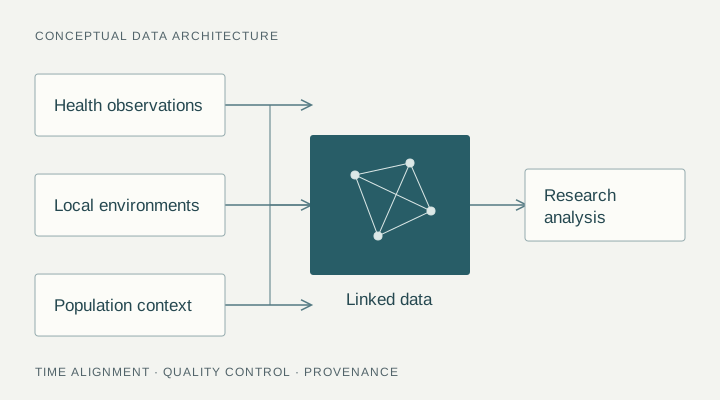
Established in October 2023, the Carl Zeiss Foundation NEXUS research group develops methods for connected climate and health data. Graph databases preserve relationships between people, households, places and observations; AI methods are investigated for understanding risk patterns and identifying research priorities.
Host: Digital Global Health, HIGH · Support: Carl Zeiss Foundation NEXUS
People & contributions
PULSE-AI develops graph-based data integration and analytical methods that inform how heterogeneous CHEERS observations can be connected and studied.
Research Group Lead / Principal Investigator
Role / research source ↗Partners & connections
Digital Global Health, shared methods and academic research collaboration
Funding through the NEXUS programme
Population-platform cooperation partner
Population research cooperation partner
Digital public health cooperation partner
Partner roles refer to the research and institutional connections documented in the linked sources.
Current status · 12 November 2026
PULSE-AI is a 2023–2028 Carl Zeiss Foundation NEXUS programme at HIGH. A 2026 knowledge-graph paper documents data integration using Nouna observations. Related AI work is research on methods and data quality; prospective clinical usefulness and early-warning performance require separate evaluation.
Publications & evidence
The labels distinguish project or site publications from related studies and shared methods. Protocols describe research designs, rather than proven health effects.
Shows how Nouna population, weather, wearable and indoor climate datasets can be linked in a knowledge graph.
Methods, findings & limitations ↗Studies generative reconstruction of missing wearable heart-rate data and its potential to support disease-signal detection.
Methods, findings & limitations ↗Introduces the modular CHEERS framework linking population surveillance, environmental measurements and individual health data.
Methods, findings & limitations ↗Research settings
Sources & updates
Profile reviewed 12 November 2026. Suggest a profile update ↗